Milky Way Galaxy
The Milky Way Galaxy is the galaxy that we are currently in...
The Milky Way is a vast barred spiral galaxy containing between 100 and 400 billion stars, including our Sun. It spans approximately 100,000 light-years in diameter and is held together by gravity, with a supermassive black hole known as Sagittarius A* at its center. Our solar system resides in the Orion Arm, roughly 26,000 light-years from the galactic core. It takes about 230 to 250 million years for us to complete one full orbit around the center. From Earth, the galaxy appears as a faint milky band of light across the sky, composed of billions of stars too distant to be seen individually.
The Andromeda Galaxy
The Andromeda Galaxy is one of the cloest galaxy to us...
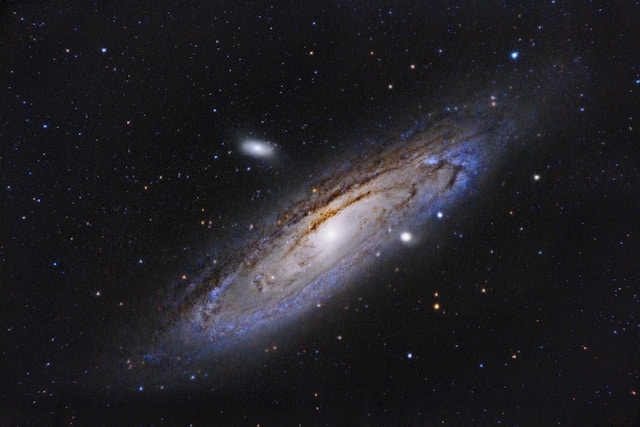
The Andromeda Galaxy, also known as Messier 31, is the closest large spiral galaxy to our Milky Way, situated approximately 2.5 million light-years away. Spanning roughly 220,000 light-years in diameter, it is significantly larger than our own and contains an estimated one trillion stars. Under dark skies, it remains the most distant object visible to the naked eye. Observations reveal a massive double nucleus at its core, likely hiding a supermassive black hole. Currently, Andromeda is racing toward us at 250,000 miles per hour. In about 4 to 5 billion years, it will collide with the Milky Way, eventually merging to form a single, massive elliptical galaxy.
Canis Major Dwarf
The canis major dward is the closest galaxy to us...
The Canis Major Dwarf Galaxy, discovered in 2003, is the closest known neighbor to our solar system, located just 25,000 light-years away. Despite its proximity, it remained hidden behind the Milky Way's dust until infrared surveys revealed its presence. This irregular galaxy contains roughly one billion stars and is currently being cannibalized by the Milky Way’s gravity. This intense tidal disruption has created the Monoceros Ring, a massive filament of stars that wraps around our galaxy three times. While some astronomers debate if it is a separate galaxy or a warp in the galactic disk, it represents a key example of how our galaxy continues to grow by absorbing its smaller neighbors.
Sagittarius Dwarf Elliptical Galaxy
a loop-shaped satellite galaxy of the Milky Way, located about 70,000 light-years from Earth...
The Sagittarius Dwarf Elliptical Galaxy (Sag DEG), discovered in 1994, is a satellite of the Milky Way located approximately 70,000 light-years from Earth. It travels in a unique polar orbit, passing through the Milky Way's galactic plane every few hundred million years. These repeated passages have stripped away stars, creating the massive Sagittarius Stream that loops around our galaxy. Research suggests these collisions may have even triggered star formation that led to the birth of our Solar System. Its core is thought to be the globular cluster Messier 54, and the entire dwarf galaxy is destined to be fully absorbed by our own within a few billion years.