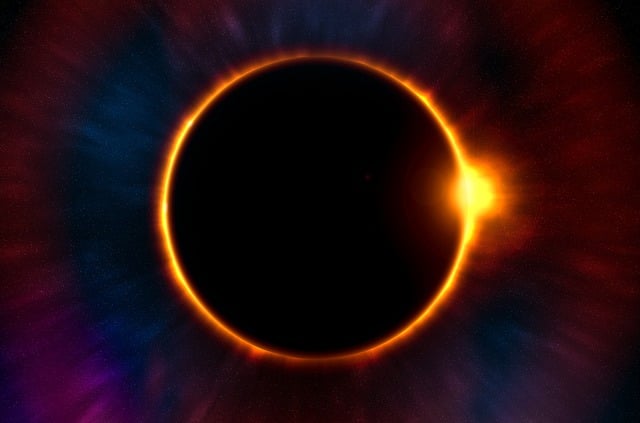
An annular solar eclipse

Stellar Systems

The Big Bang Theory

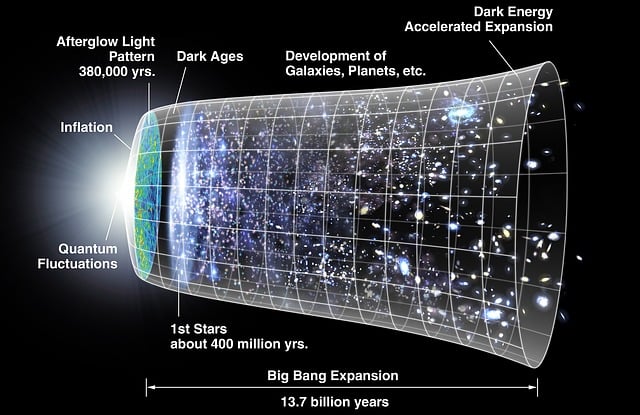
An Image of the big bang and how we think it happened The Big Bang Theory stands as the most widely accepted scientific explanation for the origin and evolution of our universe.Proposing that the cosmos began approximately 13.8 billion years ago from an infinitely hot and dense state, this theory describes how space, time, and matter first emerged and have continued to expand ever since.This page explores the journey from that initial "singular point" through the era of cosmic inflation to the formation of the first stars, galaxies, and the vast, complex structure we observe today. Dive in to uncover the evidence—from the faint echo of cosmic microwave background radiation to the redshift of distant galaxies—that supports this groundbreaking model of our orgins.
KeyWords of the Big Bang

The Big Bang theory is the leading scientific explanation for the origin of our universe, proposing it began approximately 13.8 billion years ago. According to this model, the entire cosmos started as an infinitely hot and dense "singularity"—a tiny point containing all matter and energy. A period of rapid expansion, known as inflation, caused the universe to grow and cool exponentially. Over billions of years, this cooling allowed subatomic particles to form atoms, which eventually clumped together under gravity to create the stars and galaxies we see today. Key evidence, such as the cosmic microwave background radiation and the redshift of distant galaxies, continues to support this expanding model of our universe's history.

Big Bang Expansion
The Big Bang expansion refers to the rapid and ongoing increase in the distance between points in space that began approximately 13.8 billion years ago.
The Dark Ages
The Cosmic Dark Ages began roughly 380,000 years after the Big Bang when the universe cooled enough for protons and electrons to combine into neutral hydrogen atoms. During this era, the universe was filled with a dense fog of this hydrogen gas that absorbed and scattered light, making the cosmos opaque to most radiation.
Dark Energy Accelerated Expansion
About five billion years ago, a mysterious force known as dark energy began to overcome gravity, causing the expansion of the universe to accelerate rather than slow down.This repulsive pressure now makes up roughly 68% of the cosmos and continues to push galaxies away from one another at ever-increasing speeds.
Quantum Fluctuations
Quantum fluctuations during the earliest moments of the universe acted as tiny energy ripples that were stretched to cosmic scales by rapid inflation. These microscopic variations eventually created the gravitational seeds that allowed matter to clump together and form the first stars and galaxies
Inflation
Cosmic inflation was an extremely brief period of exponential expansion where the universe grew from subatomic size to roughly the size of a galaxy in a tiny fraction of a second. This rapid stretching smoothed out space and explains why the universe appears uniform in every direction we look today.
Afterglow Light Patterns
The afterglow light pattern, known as the Cosmic Microwave Background, is the earliest light in the universe that was released about 380,000 years after the Big Bang. This faint glow acts as a snapshot of the infant cosmos, revealing tiny temperature fluctuations that eventually grew into the vast structures of galaxies we see today.
Singularity
The theoretical starting point of the universe, described as a state of infinite density and temperature where all space, time, and matter were concentrated into a single, infinitesimal point. At this point, the standard laws of physics—including Einstein's General Theory of Relativity—break down because the mathematical values for curvature and density become unlimited.